Case study
Port of Entry Order Workflow — Australia Pilot
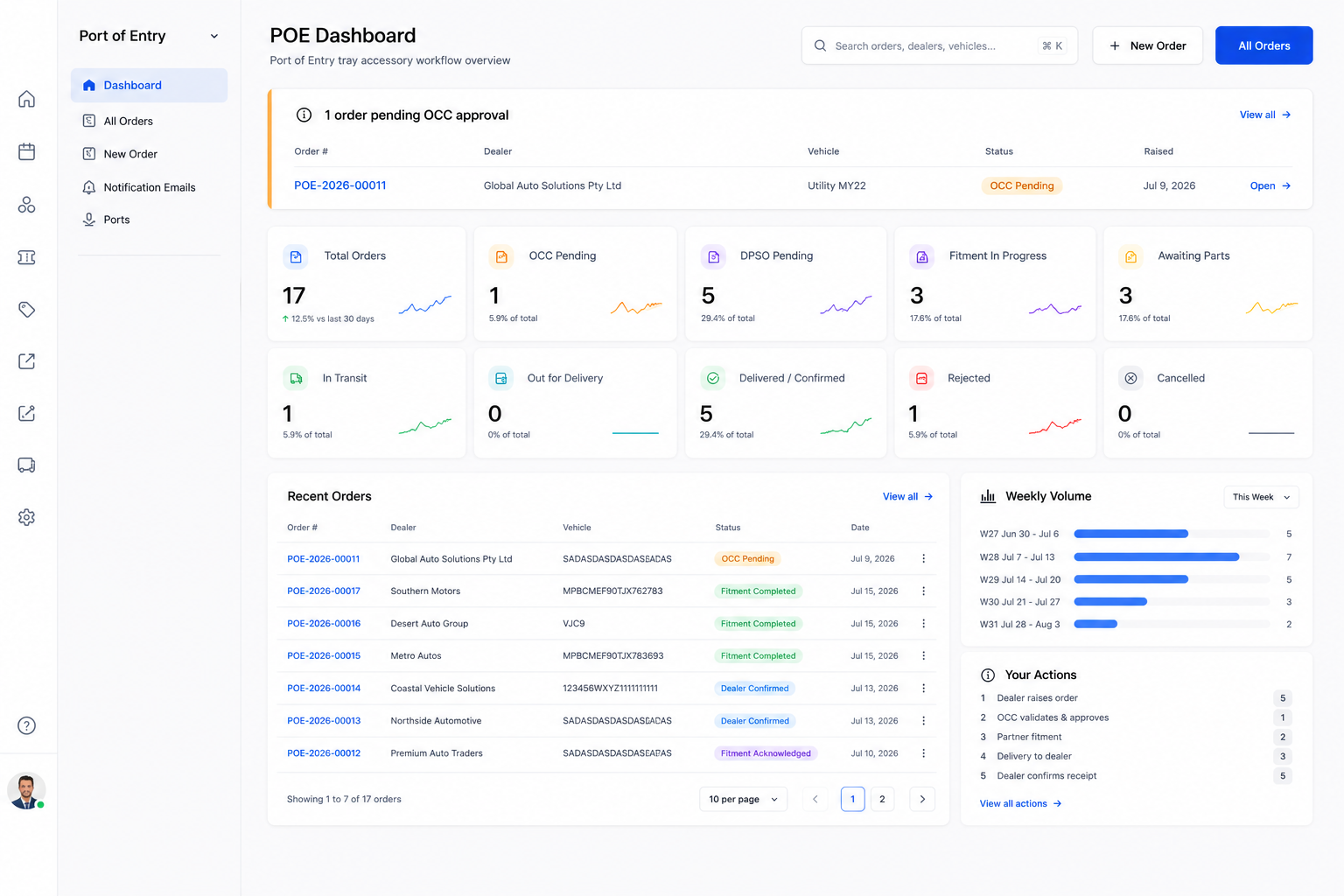
About the client
A global automotive manufacturer already running a multi-country dealer accessories portal — ordering, pricing, and dealer workflows across markets. In Australia, a separate operational problem remained: vehicle tray and fitment orders still moved through fragmented email threads and manual coordination across several internal and external parties. Status lived in inboxes. Ownership was unclear. Progress was hard to audit.
The challenge
- No single system of record for order status
- Hand-offs between parties depended on who was copied on a thread
- Limited visibility for dealers once an order left their inbox
- Harder rollout control — enabling the process for everyone at once was riskier than piloting it
What we built
01
Multi-party order workflow
Orders move through defined stages — from dealer submission through approval, release, fitment, logistics, and dealer confirmation — with only the right roles able to act at each step.
02
Market and dealer gating
Capability is controlled at market, country, and dealership level, so Australia can go live while other markets stay untouched, and only approved pilot dealers see and use POE.
03
Role-based access
Staff and dealer roles map to specific browse, create, approve, release, fitment, and confirmation actions — not a single “admin sees everything” path.
04
Catalogue and operational data
POE-eligible models, accessories, vehicle base dimensions, port and body-builder master data, and notification lists are configured so orders are complete enough to progress without dropping back into spreadsheets.
05
Automated status notifications
Each meaningful stage can notify the relevant recipients, reducing “who has this now?” chase email.
06
Pilot-first launch
The module is live in production with pilot dealers. Client stakeholders have noted that the module “has come up really well.”
Approach
This was not a greenfield app. It was a workflow product layered onto a live multi-market portal:
- Model the real operational hand-offs as an explicit state machine, not a linear form
- Gate visibility and eligibility by market, country, and dealer so pilot risk stays contained
- Align permissions with who actually owns each step
- Seed the operational data (models, dimensions, ports, notification recipients) required for a real order, not a demo
- Deploy behind feature flags and dealer enablement, then activate pilot dealers deliberately
The hard work was less “build a form” and more “make every transition safe when several organisations share one order.”
Outcomes
✓
System of record
Trackable portal workflow replaces opaque, email-heavy fitment coordination
✓
Rollout control
Australia can run POE without enabling it globally
✓
Pilot dealers
Raise and follow orders in-product with stage-level visibility
✓
Operations
Clearer ownership and fewer status gaps between stages
✓
Stakeholder feedback
Positive reception during production pilot
Technologies
Backend
Laravel — workflow state machine, role permissions, notification triggers
Frontend
React — dealer and staff order experiences on the existing portal
Database
MySQL — catalogue, master data, and order lifecycle state
Infrastructure
AWS with feature flags and dealer enablement on existing portal hosting
Why it matters
For a global OEM portal, the interesting delivery is rarely the first page. It’s the second system that has to coexist with the first — same auth, same dealers, same markets — while introducing a new operational workflow with real external hand-offs. POE is that kind of delivery: smaller surface area than the original platform, higher coordination complexity, and a live pilot that proves sustained quality on an ongoing VML engagement.
Related work
This module extends the broader enterprise dealer accessories platform — same ecosystem, new operational workflow. The dealer kits & VISTA ordering rollout later reused and extended this POE/workflow engine for kit-based order lifecycles.
Related reading
The principle behind multi-party order stages: State Is Harder Than Scale — production failures often come from ownership and synchronization across parties, not throughput.
Why market and dealer gating matters when extending a live platform: Every Integration Is a Distributed System.
Why those stages have to be a machine, not a dropdown: Why Every Workflow Is Really a State Machine.